Music Marketing: The 2026 System That Turns Listeners Into Fans
Quick answer: Music marketing is how an artist turns strangers into listeners, listeners into followers, and followers into paying fans. It's a long-term system, not a release-week push. It connects your brand, content, PR, creators, ads and streaming platforms, so every release starts stronger than the last.
Updated October 19, 2026 · By Anto Dotcom, Co-Founder, MusicPromoToday · Running artist campaigns since 2012 · 3,000+ campaigns · 40+ markets
What you'll get from this guide:
- ✅ A clear definition, and the main difference between marketing and promotion
- ✅ The fan funnel, with the one metric to watch at each stage
- ✅ A step-by-step strategy and a 90-day plan you can copy (free PDF)
- ✅ Real budgets, from DIY to multi-market, plus a budget calculator
- ✅ The mistakes and red flags that cost artists money
Read the definition below, or jump straight to the 90-day plan ↓.
In this guide
- What is music marketing?
- What does it do?
- Marketing vs promotion
- Why it matters in 2026
- The fan funnel
- What is the best way to market my music?
- What is the 3-3-3 rule for marketing?
- A 90-day plan
- Channels that work now
- DIY vs distributor vs agency
- How much does it cost?
- Common mistakes
- Red flags
- How MusicPromoToday works
- How do I get into music marketing?
- FAQ
What is music marketing?
Music marketing is the long-term work of building an audience for an artist and turning listeners into paying fans. It combines artist branding, content, PR, creators, paid ads and streaming strategy in one plan, because roughly 106,000 new tracks reached streaming services every day in 2025.
That figure comes from Luminate's 2025 Year-End Music Report. The same report found that 120.5 million of the 253 million tracks on audio platforms got 10 streams or fewer all year. Releasing music is easy. Getting it heard takes a plan.
Brands use the same term for something slightly different: campaigns that borrow music's emotional pull through sync, artist partnerships and audio ads. This guide covers the artist and label side first, and the brand side in the channels section.
What does music marketing do?
Music marketing gives the right listeners a reason to press play, then a reason to come back. In practice it does five jobs:
- Identity: defines who you are, what you sound like, and why anyone should care, with visuals, story and tone that stay consistent everywhere.
- Audience: finds the specific listeners, scenes and markets most likely to love the record.
- Content: creates the short-form video, visuals and stories that make people stop scrolling.
- Distribution of attention: uses PR, creators, paid social, playlists, radio, live shows and partnerships to put that content in front of that audience.
- Conversion and retention: turns attention into saves, follows, pre-saves, email and SMS sign-ups, merch and tickets. This is where income comes from.
If you only do job 4, and only in release week, you risk resetting your audience momentum every time.
Music marketing vs music promotion
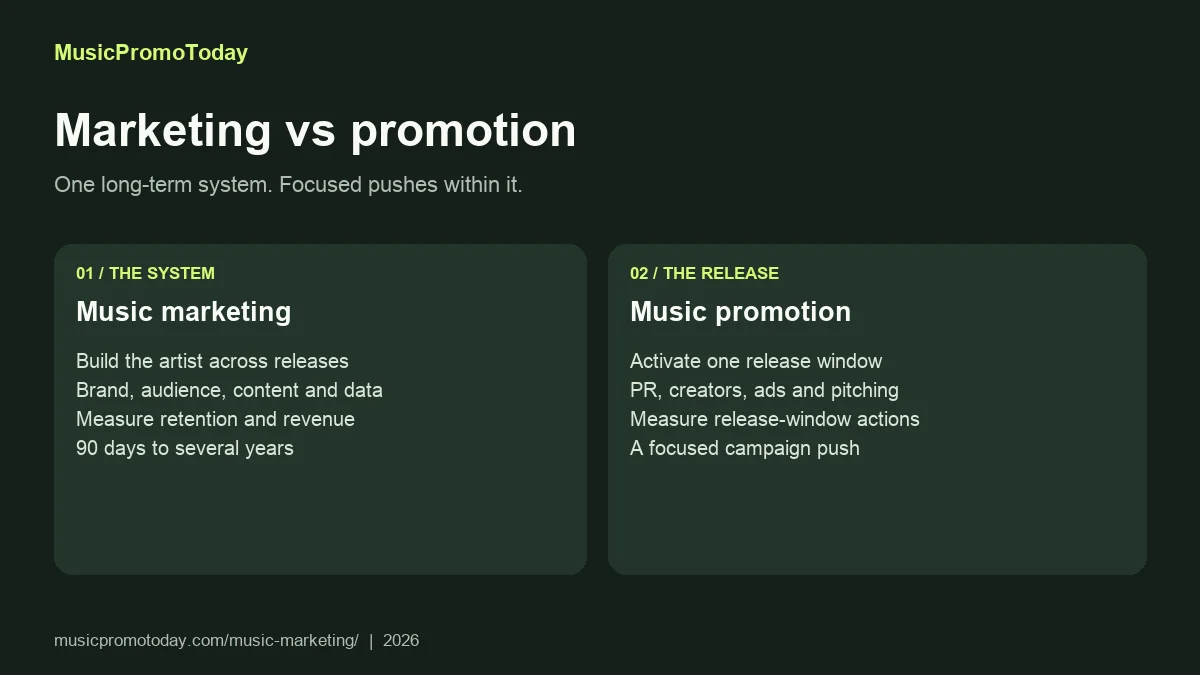
The main difference between music marketing and music promotion is time and scope. Marketing is the system that builds the artist across many releases. Promotion is the push behind one specific release inside that system. You need both, in that order.
| Music marketing | Music promotion | |
|---|---|---|
| 🎯 Question it answers | "How do we build this artist?" | "How do we push this release?" |
| ⏳ Time horizon | 90 days to several years | About 4 weeks before to 8 weeks after release |
| 🧩 Scope | Brand, audience, content, data, owned fans, revenue | PR, playlist pitching, creator seeding, ads |
| 📈 Success metric | Retained listeners, followers, email list, revenue | Streams, adds, placements and views in the window |
| 🔁 Next release | Starts stronger | Often starts from zero |
If your foundation is already in place and you just need a release pushed, see our music promotion page. If your releases keep spiking and fading, you have a marketing problem, not a promotion problem.
Why music marketing matters in 2026
Because more music is released every day than any listener could hear in a lifetime, good songs rarely find their audience on their own. Four shifts define the work right now:
- Discovery happens in feeds first. Short-form video and creator content are where many new listeners first hear a song. Streaming platforms then reward the tracks people save and replay.
- It's a singles economy. A steady release rhythm gives algorithms, playlists and fans repeated chances to find you. Many independent artists release a single every 6–8 weeks.
- Owned fans beat rented reach. Algorithms change. An email or SMS list, a community and a direct line to your superfans don't.
- AI raised the noise floor. Cheap AI tools make content faster to produce, and streaming services are tightening spam and disclosure rules. A real story and real fans are harder to copy than a beat.
AI tools: what helps and what to avoid
Use AI for the busywork: drafting captions, cutting video variations, translating press notes for new markets, and spotting patterns in your audience data. Don't use it to fake engagement or to pass off generated vocals as a human performance without saying so. Your audience and the platforms are both getting better at spotting it, and trust is the asset you're building.
The music marketing funnel
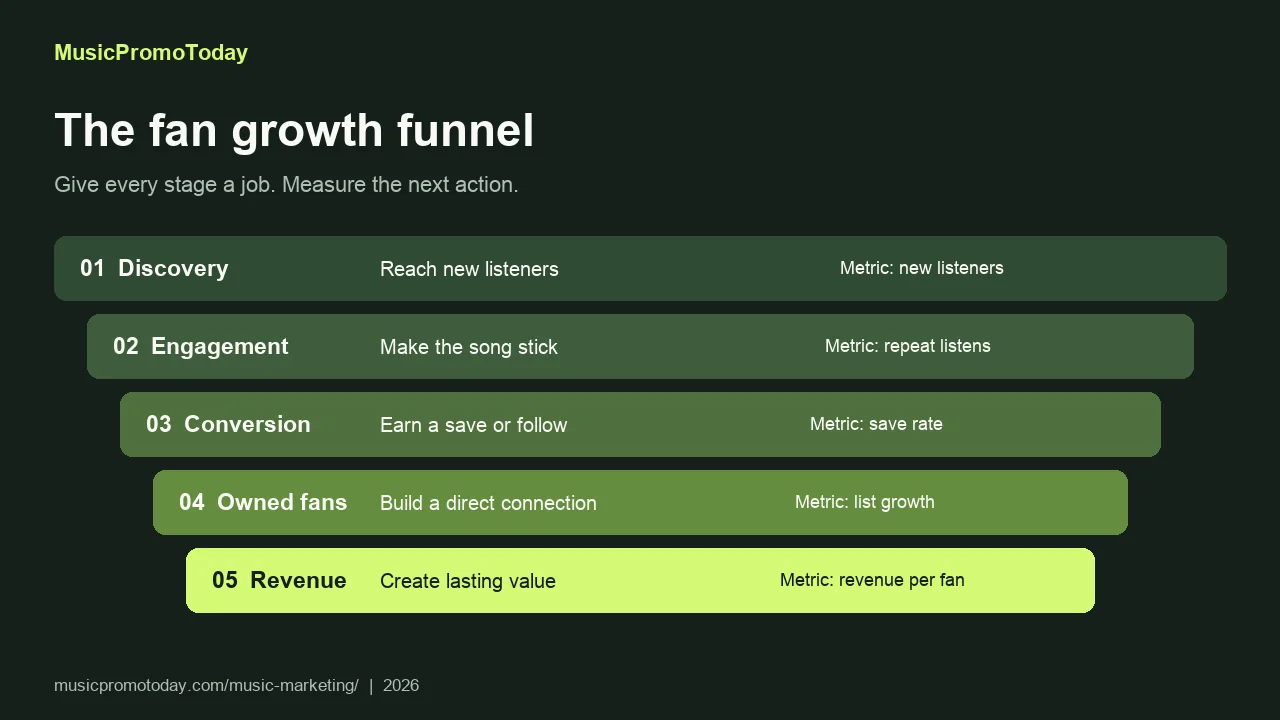
A fan funnel moves a stranger from first hearing a song to buying a ticket. Each stage needs a different channel and a different metric.
| Stage | Goal | Channels that work | Metric to watch |
|---|---|---|---|
| 👀 Discovery | New people hear the song | Creators on TikTok, Reels and Shorts, YouTube, Meta ads, PR, playlists | Reach, new listeners |
| ▶️ Engagement | They actually listen | A strong hook, Canvas, short-form series | Completion rate, repeat listens |
| 💾 Conversion | Listener becomes follower | Pre-saves, profile ads, Release Radar | Save rate, listener-to-follower ratio |
| 📬 Ownership | You can reach them without an algorithm | Email, SMS, Discord, community | List growth, open rate |
| 💸 Revenue | Fans pay | Merch, tickets, vinyl, sync, brand deals | Revenue per fan |
The most common leak is spending on discovery with no conversion step. A hundred thousand views that produce no saves or sign-ups is a vanity metric.
What is the best way to market my music?
The best way to market your music is to pick one clear goal, define who the music is for, release on a steady schedule, and fund the one channel your funnel is missing. Here's the six-step music marketing strategy we use:
- Set one primary goal. Grow monthly listeners in a new market, earn press, land a chart position, or sell out a run of shows. One goal shapes every decision after it.
- Audit your starting point. Look at streaming and social data, past campaigns and what already converts. Benchmarks beat wishes.
- Define the audience and the story. Who is this for, what do they already listen to, and what's the one-line angle press and creators can repeat?
- Plan the release cadence. Singles every 6–8 weeks suit many independents. Albums need a longer runway and a focus-track plan. In a "waterfall" release, each new single is added to the previous ones on one release page, so momentum stacks instead of resetting.
- Choose the channel mix. Don't buy the loudest channel. Buy the missing one. Great video but no credibility? Add PR. Press but weak streaming conversion? Add DSP-focused ads and pitching.
- Measure, then move budget. Review source-level results every week and move money to what's working by day 10, not day 60.
Create a world around your release
A release lands harder when it feels like a moment, not a file upload. Pick a visual theme, a phrase, and two or three recurring content formats, and use them on every touchpoint: cover art, Canvas, short-form video, press photos, merch and the live show. Fans should recognise the era in one second of scrolling.
Write an artist bio people will actually use
Your bio is the copy that journalists, curators and promoters paste into their own work. Write three versions: one line (for creators and playlists), one paragraph (for press and DSP profiles) and a full page (for your EPK). Lead with what makes you different, not a list of influences.
Endorsements, merch and showcases
Credibility compounds. A quote from a respected artist or producer, a smart merch drop for your core fans, and a showcase slot in front of industry all give press and partners a reason to take you seriously. Treat each one as content as well as a milestone.
What is the 3-3-3 rule for marketing?
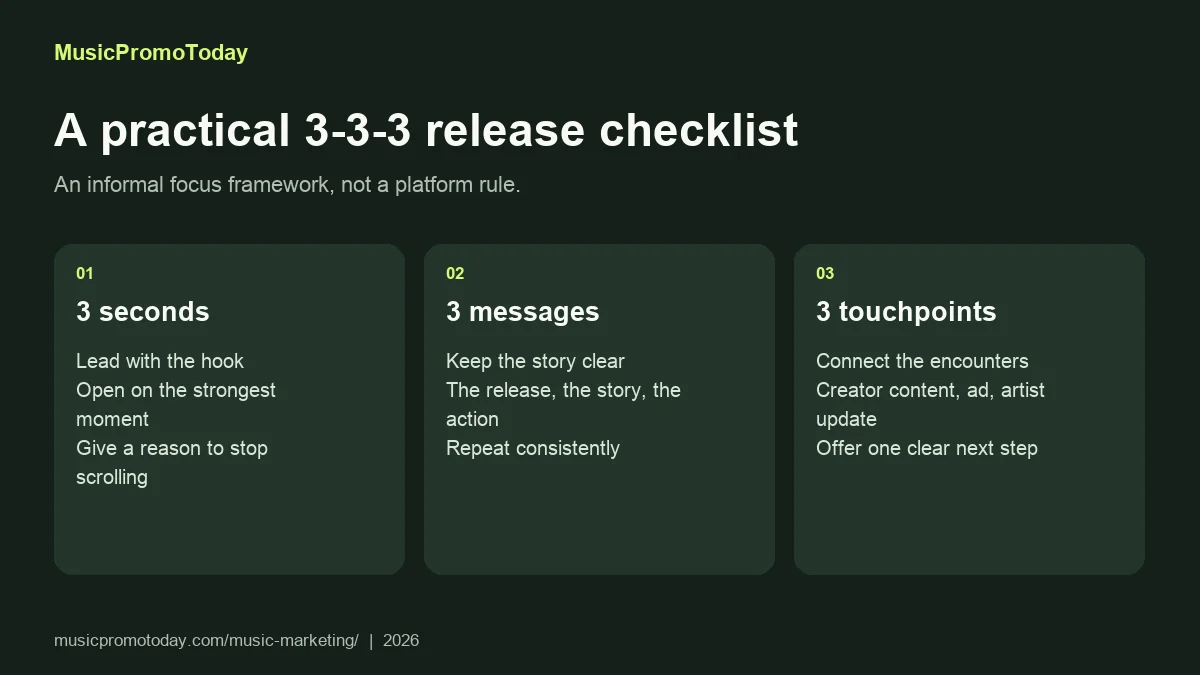
The 3-3-3 rule is an informal focus framework, not an official standard, and marketers use a few versions of it. One practical version for release content is: hook people in 3 seconds, stick to 3 core messages, and reach them through at least 3 touchpoints.
For a release, that looks like this:
- 3 seconds: your video has to land the hook before the thumb moves on. Open on the best part of the song, not the intro.
- 3 messages: for example, "new single out Friday," "the story behind it," and "pre-save now." Drop everything else.
- 3 touchpoints: a fan sees a creator video, then your ad, then your Release Radar update. Three consistent encounters make the next step feel natural.
A 90-day music marketing plan
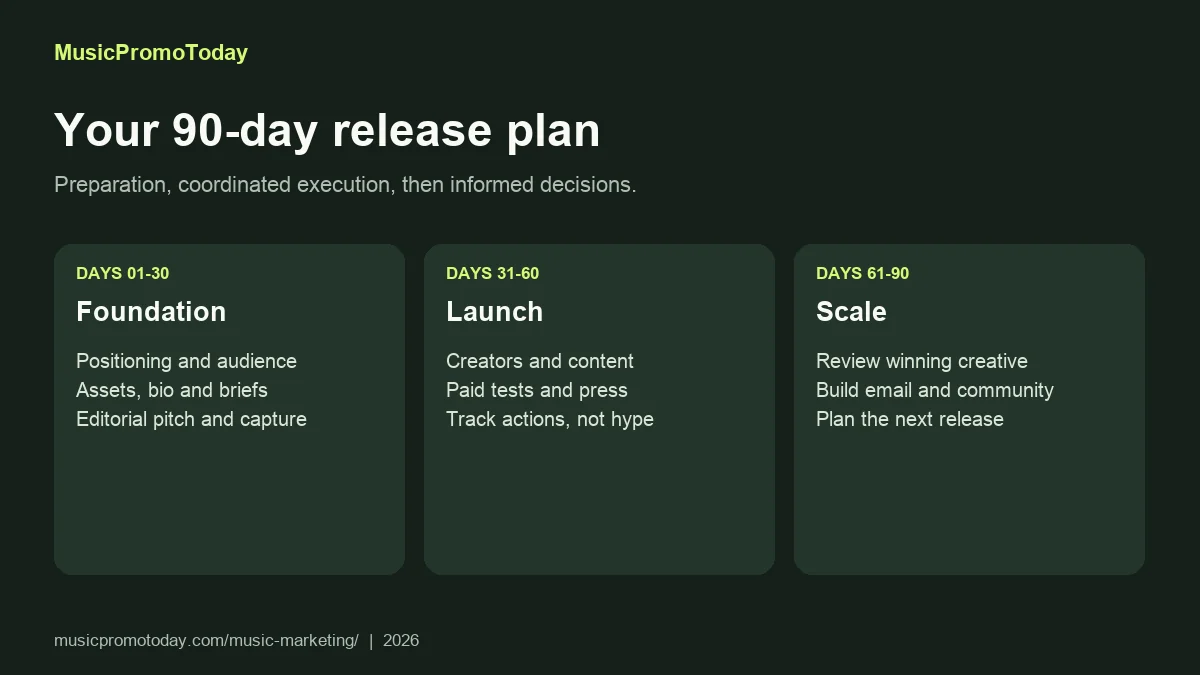
Ninety days gives each channel time to compound: 30 days to build, 30 to launch and 30 to scale.
| Window | Focus | Key actions |
|---|---|---|
| 🧱 Days 1–30 (pre-release) | Foundation | Positioning, assets, bio, press outreach, creator briefs, pre-save, email capture, and your Spotify editorial pitch (at least 7 days before release, ideally 3–4 weeks) |
| 🚀 Days 31–60 (release) | Launch | Creator content goes live, paid social tests, press lands, DSP push, daily short-form content |
| 📈 Days 61–90 (post-release) | Scale | Double down on the winning creatives and markets, follow-up single or remix, move listeners to email and SMS, plan the next cycle |
Spotify says that if you pitch an unreleased song at least 7 days before release, it goes into your followers' Release Radar playlists. Pitching doesn't guarantee editorial placement, but skipping it wastes a free conversion step.
Free PDF + editable planning template
Your next 90 days, mapped out.
Get the Music Marketing Plan 2026: weekly tasks, channel picker, budgets, the 3-3-3 checklist and red flags.
Want it built for you, with dates, owners and budgets? See release planning.
Music marketing channels that work now
The best channel is the one that fixes your weakest funnel stage. Here's what each one does well:
- Music PR: credibility, press quotes and search results for your name. Essential before tours, brand deals and editorial pitches. → Music PR
- Creator and influencer partnerships: the fastest discovery engine when the hook is strong. Brief creators with a clear trend or story, not just "use my sound." → TikTok and creator campaigns
- Paid social: optimise for saves and follows, not cheap views. Make ads feel native to the feed and start small. → Music advertising
- Spotify and other DSPs: clean metadata, an editorial pitch, Canvas, and approved tools like Discovery Mode where they make sense. → Spotify and DSP strategy
- YouTube: long-tail discovery, where views keep compounding for years.
- Direct-to-fan: email, SMS and community you own. → Direct-to-fan strategy
- Live events: shows, livestreams and listening parties turn online fans into local ones and give you content for months.
- Partnerships: merch, sync and brand deals turn attention into revenue. → Brand partnerships
| Channel | ✅ Pros | ❌ Cons |
|---|---|---|
| 📰 PR | Lasting credibility and search results | Slow to show in streams |
| 🎥 Creators | Fast discovery, social proof | Depends on a strong hook |
| 📣 Paid social | Controllable, measurable | Burns money without a conversion step |
| 🎧 DSPs | Turns listeners into followers | No placement is guaranteed |
| 📬 Email and SMS | You own it, no algorithm | Slow to build from zero |
For labels and brands: labels use it to build rosters and catalogs, not just single releases. Brands use it to borrow music's emotional pull through artist partnerships, sync and creator content. → Label marketing
DIY vs distributor marketing vs agency
The right option depends on your budget, your time, and how many channels have to work together.
| 🛠️ DIY + tools | 📦 Distributor marketing | 🎯 MusicPromoToday | |
|---|---|---|---|
| Typical cost | $0–$500 per release | Often bundled; pitching is selective | Sprint $2,500 · focused from $5,000 · integrated ~$24,000 |
| Channels | What you can run yourself | Mostly DSP pitching, ad tools, mailers | PR + creators + ads + DSP + owned fans |
| Strategy | You | Light | Senior strategist, written plan |
| Lock-in | None | You must distribute with them | None. Keep your distributor |
| Reporting | Platform dashboards | Varies | Client dashboard, source-level reports |
| Best for | Early releases, testing | Catalog support | Serious singles, albums, rosters, new markets |
DIY. Pros: cheap, full control, you learn fast. Cons: slow, and one person can rarely run five channels well. Distributor marketing. Pros: convenient and often bundled. Cons: limited channels and light strategy. Agency. Pros: one accountable team running several channels on one timeline. Cons: it costs more, so it only makes sense when the music and the goal justify it.
If your budget is a few hundred dollars, start DIY. A free editorial pitch and a steady content habit beat a badly funded campaign.
How much does music marketing cost?
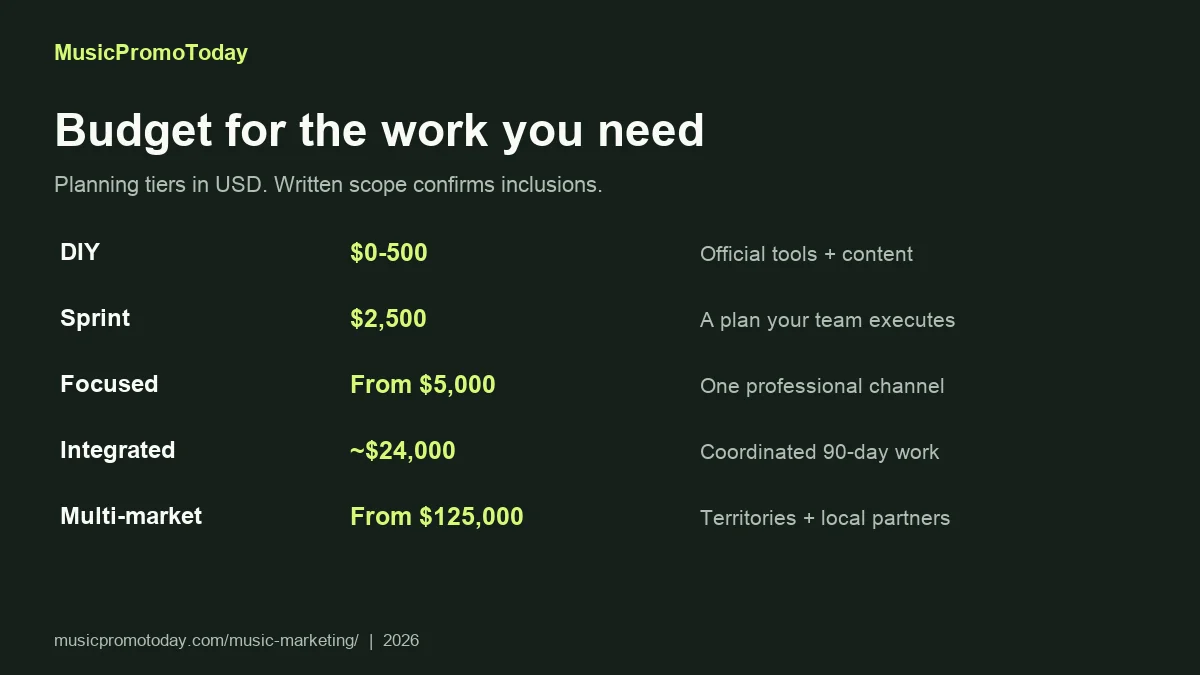
Music marketing costs anywhere from $0 for DIY to six figures for multi-market campaigns. Here's what each level buys at MusicPromoToday:
| Level | Budget | What it buys |
|---|---|---|
| 🛠️ DIY | $0–$500 | Free DSP pitching, organic content, small ad tests |
| 🧭 Release Strategy Sprint | $2,500 | Audit, audience, positioning and a channel-by-channel plan you can run yourself |
| 🎯 Focused channel | From $5,000 | One professional channel: PR, creators, DSP or YouTube |
| 🔗 Integrated 90-day campaign | Typically ~$24,000 | PR + creators + paid social + DSP, coordinated, with weekly reporting |
| 🌍 National / multi-market | from $125,000 | Several territories, local partners, larger media spend |
Ad spend and creator fees are itemized in a written scope, so you always see what goes to media and what goes to the agency.
Planning tool · No email required
Find your starting tier
Suggested starting point · Single
Integrated 90-day campaign
Typically ~$24,000
Three or more channels in one market need a coordinated foundation, launch and scale cycle. Goal: streams in a new market.
Timing supports preparation; deliverables and lead times are agreed before launch.
Get this plan built →How the recommendation works
Under $500: DIY. Plan only: $2,500 Sprint. One channel: Focused from $5,000. Two channels: manually scoped Focused work. Three or more channels in one market: integrated, typically $24,000. Three or more in multiple markets: from $125,000. Goal, release type and timing inform the review; they do not create an automatic quote. No media-versus-fee percentage or results forecast is assumed.
Campaign evidence, not invented averages. The public case studies below report named campaign results. We do not publish a median campaign length, media-versus-fee percentage or most-common goal without an approved, defined dataset. Your written scope sets those details for your campaign.
Common music marketing mistakes
These are the complaints that come up again and again in artist communities like r/musicmarketing, and in the campaigns we're asked to rescue:
- Paying for streams or "guaranteed" playlist spots. Spotify says these services are scams, and artificial streams earn no royalties, don't count toward charts, and can get a track removed.
- Running ads to the wrong goal. Cheap views feel good, but if the ad isn't built to drive saves and follows, the algorithm learns nothing useful.
- Treating release day as the finish line. Most campaigns stop just when the data starts telling you what works. The 30 days after release are where you scale.
- No way to reach fans directly. Without an email or SMS list, every release starts from zero again.
- Changing the sound and look every release. Fans can't build a habit around an artist they don't recognise.
- Copying a big artist's rollout without the audience. Superstar tactics depend on attention you may not have yet. Borrow the structure, not the scale.
- Hiring before you know your goal. If you can't say what success looks like in one sentence, no agency or tool can deliver it.
Red flags when choosing music marketing companies
Walk away from anyone who:
- 🚩 Guarantees streams, followers or placement on official Spotify playlists
- 🚩 Won't separate ad spend from fees
- 🚩 Shows no named case studies or source-level reports
- 🚩 Charges before anyone has listened to your music
- 🚩 Has prices that only make sense if the engagement is fake
We use real PR, real creators, transparent ads and approved platform tools. Never bots.
How MusicPromoToday works
We start from the record and the goal, not from a package.
- Foundation. You send the music, objective, timeline and budget. We review fit manually and reply within one business day.
- Build. We define the audience, story, markets and channel mix, and write it down with dates and owners.
- Launch. PR, creators, ads, DSP and direct-to-fan run as one campaign on one timeline.
- Optimize. Your client dashboard shows results as they come in. We move budget toward what's working and plan the next cycle.
Integrated campaigns work best with 8–12 weeks of runway. Music that's already out can still be marketed through catalog and creator-led campaigns.
Results and examples
"My nephews. Kings of music marketing campaigns." Snoop Dogg, Global Icon · Death Row Records
Since 2012, MusicPromoToday has run 3,000+ campaigns across 40+ markets, working with artists including Snoop Dogg, Loe Shimmy and Dimash. The company's founders were featured in Billboard, and co-founder Anto Dotcom wrote about artist management for Rolling Stone Culture Council.
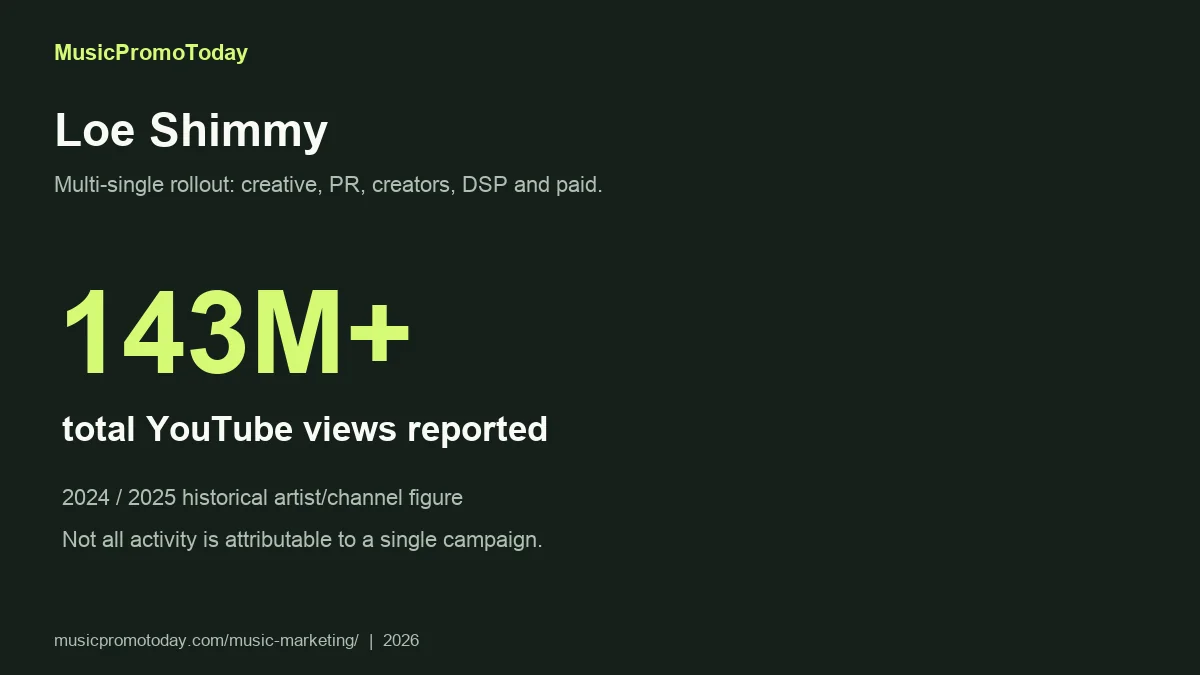
- Loe Shimmy: multi-single rollout, 143M+ YouTube views reported and a Billboard Hot 100 debut. Read the case study
- Penomeco: global crossover campaign, +850K Western fans in 6 months and 12M YouTube views
- O.T & Elesia × 50 Cent, "Prayed Up": 9.1M+ YouTube views and 1.6M+ Spotify streams
- Ado, "Episode X": 8M+ YouTube views and creator participation at scale
These are reported historical artist or release figures, not a claim that every view or stream was caused by our work. Results vary by artist and campaign. See all case studies →
How do I get into music marketing?
Start by marketing real releases: your own, or a friend's. Learn the platform dashboards, document the starting point, agree on one goal, and record what changed. Build a small portfolio with the dates, work delivered, spend and results clearly separated. Then look for internships or junior roles at labels, distributors, management companies and agencies. Courses can help, but practical campaign experience gives you evidence to discuss.
FAQ
What does music marketing do?
It gives the right listeners a reason to play your music and a reason to come back. It covers your brand, audience, content, channels and the step that turns listeners into followers, email subscribers and paying fans.
What is the 3-3-3 rule for marketing?
It's an informal framework with a few versions. One practical version is: hook people in 3 seconds, keep to 3 core messages, and reach them through at least 3 touchpoints. For a release, that means a fast hook, a simple message and consistent repetition.
What is the best way to market my music?
Pick one goal, define who the music is for, release on a steady schedule, and fund the channel your funnel is missing. For most independent artists, that means short-form video, an editorial pitch and an email list before paid ads.
How do I get into music marketing?
Start by marketing real releases: your own, or a friend's. Learn the platform dashboards, build a small portfolio of campaigns with results, then look for internships or junior roles at labels, distributors, management companies and agencies. Courses help, but results get you hired.
What's the difference between music marketing and music promotion?
Music marketing is the overall system that builds the artist over time. Music promotion is the campaign push behind a specific release. Promotion works better when the marketing foundation is already in place.
How much does music marketing cost?
DIY can cost under $500 per release. At MusicPromoToday, a strategy sprint is $2,500, focused work starts at $5,000, integrated 90-day campaigns are typically around $24,000, and multi-market campaigns run from $125,000. Media spend is itemized separately.
How early should I start marketing a release?
Start 8–12 weeks before release for an integrated campaign. At a minimum, pitch Spotify editorial at least 7 days before release day so the song reaches your followers' Release Radar.
Do music marketing agencies guarantee results?
No honest agency can guarantee streams or editorial placements. What you should get is a written strategy, transparent spend and source-level reporting.
Ready to build your music marketing plan?
Send us the music, the goal and the timeline. Because every plan starts from your record, not a package, we'll review it within one business day and tell you honestly whether we're the right team.
Free PDF + editable planning template
Your next 90 days, mapped out.
Get the Music Marketing Plan 2026: weekly tasks, channel picker, budgets, the 3-3-3 checklist and red flags.
About the author: Anto Dotcom is Co-Founder of MusicPromoToday, which has run marketing, PR and creator campaigns for artists and labels since 2012, across 40+ markets. About MusicPromoToday · Instagram · LinkedIn · Anto Dotcom on LinkedIn