
EP vs Album vs LP: How to Choose the Right Format Now
The format you release music in is not a creative afterthought. It is a business decision with direct consequences on streaming revenue, algorithmic reach, Grammy eligibility, playlist placement, and long-term catalog value. Yet the EP vs album vs LP conversation — and everything tangled inside it, including LP vs EP meaning, the practical difference between EP and album, and where a mixtape or deluxe edition fits in — is still poorly understood by a significant portion of the artists and managers making these calls every release cycle.
This breakdown addresses that gap.
Defining the Formats: What the Industry Actually Means
Before getting into strategy, the definitions need to be precise, because they vary depending on who is drawing the line.
A single on Spotify and Apple Music is 1–3 tracks, each under 10 minutes, with a total runtime under 30 minutes. An EP is 4–6 tracks with a total runtime at or under 30 minutes. An album — also referred to as an LP, short for long-play — is 7 or more tracks regardless of runtime, or any release exceeding 30 minutes regardless of track count. That is the DSP classification, and for the purposes of streaming strategy, it is the most operationally relevant definition.
The EP vs album distinction becomes more layered when you factor in other bodies. The Recording Academy defines an album as at least 5 distinct songs totaling 15 or more minutes, or any project with a runtime of 30 or more minutes — a threshold that determines Grammy eligibility. The RIAA defines an album as 6 or more tracks or over 30 minutes. The UK Official Charts Company draws the line at more than 4 tracks or more than 25 minutes. There is no universal global standard. The discrepancy is not academic — it directly affects where a release lands on charts, what awards it qualifies for, and how distributors categorize it when pitching to editorial teams.
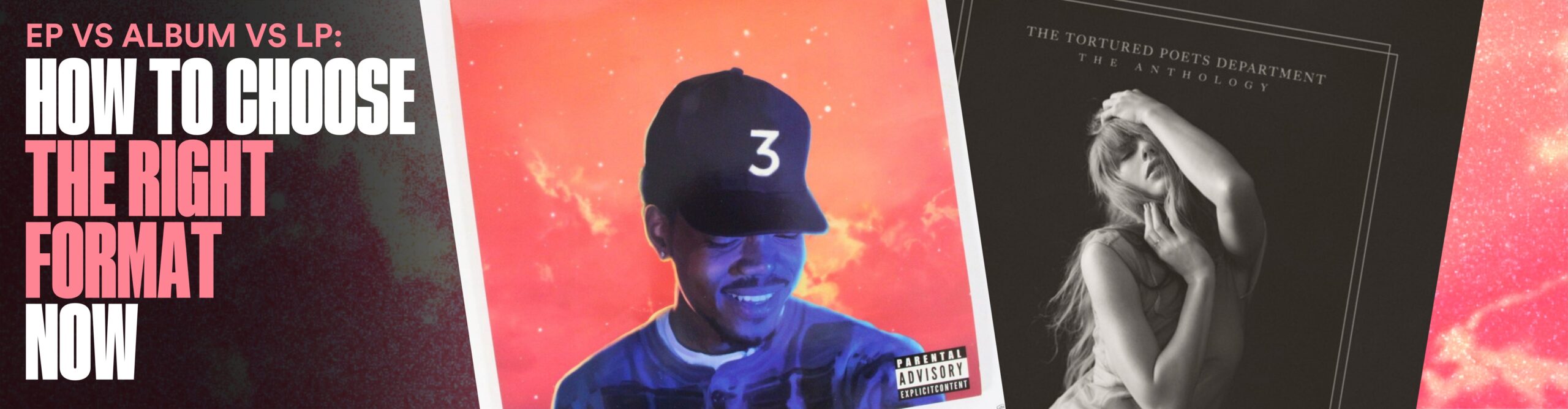
The album vs EP vs LP distinction is further complicated by adjacent formats. A mini-album, dominant in K-pop, typically contains 4–7 tracks with one designated title track and carries full promotional weight — music video, media appearances, physical packaging — without reaching full LP territory. Platforms classify mini-albums as EPs or albums based on standard thresholds. A mixtape, meanwhile, has no DSP classification of its own. It is a cultural label, not a metadata category. Chance the Rapper’s Coloring Book won Best Rap Album at the 59th Grammys as a “mixtape.” The streaming era rendered that distinction functionally meaningless.
What Streaming Changed About Format Logic
Understanding the LP vs EP meaning in a modern context requires understanding how the revenue model shifted. Before streaming, the album was a forced bundle. A CD retailed at $15–$18. Labels captured roughly $4–$5 per unit. Consumers paid for 12 tracks to access the 2 they actually wanted. That model made the LP economically dominant by default.
Streaming broke the bundle entirely. Revenue is now generated per stream, not per unit — and the per-stream economics are blunt. Spotify pays approximately $0.003–$0.005 per stream. Apple Music pays roughly double at $0.007–$0.01, partly because it operates without a free tier. Across all platforms, the global average landed at $3.41 per 1,000 streams in 2024, down from $3.69 in 2022. A 20-track album does not inherently earn more than four 5-track EPs. What matters is total streams generated per track, not total tracks released.
The structural consequence is significant. According to a Stat Significant analysis published in early 2026, nearly 75% of songs capture 5% or less of their album’s total streaming activity. Attention concentrates around two or three tracks. The rest accumulates minimal plays and, under Spotify’s 2024 policy requiring 1,000 streams annually for a track to generate royalties at all, risks generating nothing. That threshold — effective April 1, 2024 — shifts approximately $40–46 million annually away from sub-threshold tracks toward qualifying ones. On a 15-track album from an emerging artist, tracks 8 through 15 may never cross that line. On a focused 5-track EP, the probability of each track earning improves considerably. That math alone should reshape how artists approach the EP vs album decision.
The Algorithmic Case for the EP
The EP vs album question often gets framed as a creative choice, but algorithmically, format matters less than most artists assume — and simultaneously more than they act on.
Spotify does not editorially favor albums over EPs or vice versa. What it does do is grant each release exactly one editorial pitch through Spotify for Artists, regardless of whether that release is a single, EP, or 15-track album. That single-pitch rule is one of the most consequential mechanics in modern release strategy. An artist releasing four singles before an EP gets four separate editorial submissions, four appearances in Release Radar, and four algorithmic testing windows. An artist who drops a 12-song album cold gets one.
Release Radar updates every Friday, shows one track per artist per week, and keeps tracks visible for up to 28 days. Discover Weekly, which refreshes every Monday and is built on long-term listening patterns rather than release timing. What it responds to is signal quality: save rate, completion rate, repeat listens, and low skip rates observed consistently over time, with the system typically waiting 1–2 weeks post-release before testing a track against new listeners. Each release resets these windows. More releases equals more windows.
That is the core algorithmic argument for the singles-to-EP-to-album waterfall strategy, which has become the dominant release framework for independent artists over the past several years. The mechanics work as follows: release a standalone single, then release a second single that includes the first as a second track using the same ISRC codes, and continue building until the EP or album release compiles all tracks. Each track must carry matching ISRCs across releases so stream counts merge and accumulate toward the final project. The result: a project that already has momentum before it officially drops.
EP vs Album: When the Album Is the Right Call
None of this makes the LP obsolete. The album remains the format of artistic authority, media leverage, and catalog longevity, but it requires the conditions to support it.
The album works when there is an established fanbase ready to consume a full-length project, when label or management infrastructure exists to fund a coordinated press and promotional campaign, and when award positioning is a priority. Grammy album categories — including genre-specific awards and Album of the Year — require a minimum of 5 tracks totaling at least 15 minutes, or any project exceeding 30 minutes total runtime. Releases that fall below those thresholds are ineligible for album categories regardless of how they are marketed. Artists aiming for that level of industry recognition need the LP.
The physical market reinforces this. Vinyl LP sales reached 43.6 million units in 2024 — $1.4 billion in revenue, the format’s 18th consecutive year of growth. Taylor Swift’s Tortured Poets Department sold 1.489 million vinyl copies in that cycle. Physical merch tied to a full album release drives revenue streams that a 5-track EP simply cannot anchor at the same scale. That said, vinyl production timelines currently run 8–14 weeks for standard orders, meaning the physical rollout must be planned well before the digital release.
The album is also the better vehicle when the artistic statement itself requires length — when the sequencing, thematic arc, and collective listening experience are central to the work. Releasing 8 tracks as an EP because the album feels “too ambitious” is the wrong reason to truncate a project.
EP vs Album: The Decision Framework
The difference between EP and album is ultimately a question of where an artist sits in their career cycle, what their resources support, and what the specific release is trying to accomplish.
Release an EP when the goal is catalog-building, algorithmic presence, or sound-testing on a limited budget. Release a single when the goal is playlist targeting, sync licensing, or momentum maintenance between larger projects. Release an album when there is a fanbase to receive it, a press campaign to amplify it, physical revenue to anchor it, and — if awards matter — a tracklist built to meet the eligibility thresholds.
In practical terms, the most durable framework running through all three formats is consistency. Spotify research indicates listeners are more likely to save tracks from artists with consistent release patterns. Algorithms reward active catalogs. The artists who understand that the EP vs album decision is not a one-time choice but a sequenced strategic plan, each format doing a specific job at a specific stage, are the ones building sustainable streaming revenue rather than chasing a single release cycle.
The Next Step
Audit your current release plan against your monthly listener count, editorial pitch history, and catalog depth. If you have not been waterfall releasing, you have been leaving algorithmic surface area on the table. If you have been releasing albums without the fanbase to support them, you have been concentrating risk in a format that demands volume. Build the format choice into the release strategy from the first session, not the last.
MusicPromoToday (MPT Agency) works with artists, managers, and labels navigating exactly these decisions — from release sequencing and editorial pitching to full album campaign strategy. The format question is always the starting point, but the execution is where careers are built or stalled. If your current release plan does not account for algorithmic surface area, or royalty threshold mechanics, it is time to rebuild it from the ground up. That is the work MusicPromoToday does every release cycle, and the reason the EP vs album decision never gets made in isolation.

